
It’s not just about dolphins: discover a magical underwater world. When we talk about dolphin sighting Golfo Aranci, … we are actually talking about one of the richest and best-preserved marine ecosystems in the Mediterranean. In this article, we’ll take you on a journey of discovery through the waters that bathe Cape Figari, the island of Tavolara and the Costa Smeralda, explaining why this stretch of sea is a veritable sanctuary of biodiversity. If you love nature, the snorkelling and you want to understand What to see in Olbia and the surrounding area Beyond the beaches, read on.
1. The Pelagos Marine Protected Area: a protected area of global significance
L’Golfo Aranci marine ecosystem falls within the scope of Pelagos Cetacean Sanctuary, a marine protected area established in 1999 by Italy, France and the Principality of Monaco. Covering 87,500 km², Pelagos is the largest marine mammal conservation area in the Mediterranean and one of the largest in Europe. This means that human activities – from fishing to shipping – are regulated to minimise their impact on wildlife. For those who choose Nautical Service, sailing in these waters means doing so in full compliance with the regulations, with skippers who have been specifically trained in best practices for sightings.
But what makes this area so special from a biological point of view? The convergence of currents, the varying depth (which ranges from a few metres near the shore to over 2,000 metres in the channel between Sardinia and Corsica) and the abundance of plankton create a reservoir effect: nutrients rise from the depths, feeding rich food chains and attracting predators of all sizes. It is no coincidence that not only dolphins, but also fin whales, striped dolphins, Risso’s dolphins and even sperm whales (rarer, but sighted) live here permanently.
Scientific fact: The Pelagos Sanctuary is home to around 8 different species of cetaceans out of 11 in the Mediterranean. No other area in the basin has such a high concentration.
2. The Posidonia meadow: the Mediterranean’s blue lung
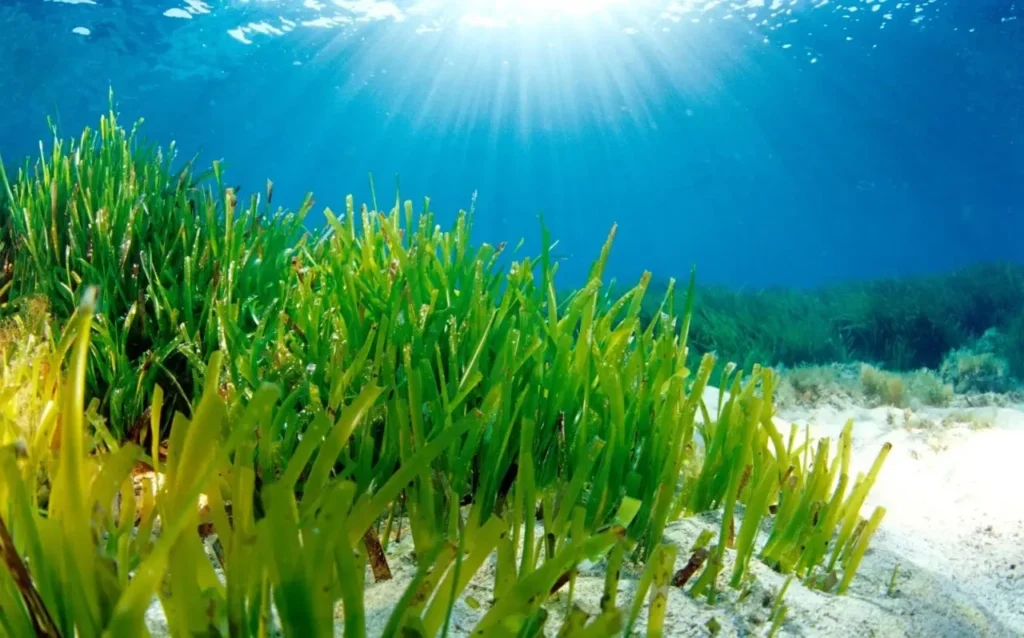
Beneath the gulf’s seemingly uniform surface lies a Posidonia oceanica seagrass meadow (Posidonia oceanica) – among the largest and best-preserved in north-eastern Sardinia. Posidonia is not a seaweed, but a higher plant (angiosperm) that produces flowers and fruit, lives for up to 100,000 years and forms meadows comparable to rainforests in terms of ecological importance. One hectare of Posidonia produces up to 20 litres of oxygen a day, sequesters carbon dioxide, stabilises the seabed and serves as a natural nursery for hundreds of fish species.
The Posidonia seaweed that washes up on beaches (known as “banquettes”) is not rubbish: it is a natural defence against coastal erosion. In the’Golfo Aranci marine ecosystem, Posidonia seagrass beds are found at depths of between 5 and 30 metres, mainly off Pittulongu, Cape Figari and around Tavolara. During the snorkelling stops at Nautical Service, you can swim above these seagrass beds and observe the marine life they are home to: seahorses, starfish, edible sea urchins (be careful not to step on them!), white seabream, grey mullet and striped seabream.
Practical tip: Do not touch or pull up the Posidonia. It is protected by law (Habitat Directive 92/43/EEC) and damaging it is an offence. Swim on the surface or with fins without touching the seabed.
3. Capo Figari: a headland that feeds the sea
Cape Figari it’s not just a place from which to enjoy a breathtaking panorama at Olbia e Tavolara. This headland of granite and limestone, which juts out into the sea for over 2 km, plays a crucial role in the’Golfo Aranci marine ecosystem. Its waters are rich in underwater freshwater springs (a phenomenon known as “upwelling”) that rise from the depths, causing local changes in salinity and temperature. These changes attract plankton and small fish, which in turn attract predators such as dolphins, tuna and garfish.
Furthermore, the seabed around Capo Figari is characterised by vertical cliffs overlooking the sea (ideal for reef checks) and from partially flooded caves which can only be explored by experienced divers. The most famous are the Grotta del Papa and the Grotta dei Colombi. During the excursion with Nautical Service, the skipper will take you past these caves, telling you the legend of the smugglers who used them to hide goods and cigarettes. If you’re lucky, you might see cormorants, major events (rare seabirds) and peregrine falcons which nest on the walls.
Curiosity: The name “Figari” derives from the Latin “ficus” (fig). The headland was once covered in prickly pears and wild figs, which have now been replaced by Mediterranean scrub (mastic, arbutus, myrtle and rockrose).
4. Tavolara: a mountain that plunges into the blue
The island of Tavolara is the visual symbol of Olbia and surroundings. Standing 565 metres tall and with its square shape (which does indeed resemble a table), it is a monolith of dolomitic limestone which rises out of the sea like a wall. But what you can’t see is that Tavolara continues underwater to a depth of over 80 metres, creating a system of underwater walls, canyons and natural arches that are a paradise for divers and snorkellers. The area around the island is Marine Protected Area since 1997, and fishing has been banned or strictly regulated.
This protection has enabled the fish population to recover remarkably. Swimming in the waters around Tavolara (for example in the Piscina di Venere, a natural lagoon on the west coast), you may come across grouper (including specimens over a metre long), barracuda, disappear of every species, moray eels e lobsters. The Posidonia meadows here reach their full growth, with leaves up to a metre long. During the snorkelling stops at Nautical Service, people often stop right in front of the beach at Cala di Trana or to Coater Tip, two spots with shallow waters teeming with life.
Important rule: In the Tavolara Nature Reserve, anchoring is only permitted at authorised points. Boats Nautical Service use mooring lines on land or eco-friendly buoys, so as not to damage the Posidonia.
5. Marine species you might spot (as well as dolphins)
L’Golfo Aranci marine ecosystem It’s a veritable blue jungle. Here are some of the species you might encounter during the excursion with Nautical Service, in addition to the main protagonists (bottlenose dolphins and common dolphins):
| Species | Where to see it | Best period |
|---|---|---|
| Loggerhead sea turtle | Surface, as it breathes | May-September |
| Common fin whale (the second-largest cetacean in the world) | Deep waters between Tavolara and Corsica | April-June |
| Striped dolphin (the smallest and fastest dolphin) | Herds of 20–50 individuals | June-September |
| Bluefin tuna | Passage areas between Capo Figari and Tavolara | May–July |
| Sunfish (Mola mola) | On the surface, it drifts with the currents | July-August |
| Sardinian red prawn (Aristolteus antennatus) | Depths of over 400 m – visible only to professional divers | All year round (regulated fishing) |
| Red coral (Corallium rubrum) | The vertical walls of Capo Figari (visible when snorkelling at depth) | All year round |
Note: Humpback whales are rare and can only be spotted on early morning trips (departing at 7:00 am) from April to mid-June. Ask at Nautical Service if they organise special outings.
6. Why this ecosystem is ideal for snorkelling
If you love snorkelling, the’Golfo Aranci marine ecosystem will offer you some of the best experiences of your life. Here’s why:
Crystal-clear waters: Visibility often exceeds 20–25 metres from May to October, thanks to the lack of rivers carrying sediment and the Posidonia seagrass that stabilises the seabed.
Variable backdrops: In just a few hundred metres, you pass from Posidonia meadows (depth 5–10 m) to granite rocks (10–20 m) and sheer drop-offs (over 30 m). Perfect for all levels.
Calm waters: The snorkelling stops at Nautical Service They are always held in sheltered coves (Cala Moresca, Cala del Sonno, Piscina di Venere) where there are no currents or waves.
Confident wildlife: In protected areas such as the Tavolara Nature Reserve, the fish aren’t afraid of divers. Groupers approach curiously, and schools of white seabream follow you.
Fresh spring water: Some spots (such as the spring at Capo Figari) produce strange thermocline effects – layers of water at different temperatures that create visual “mirages”.
Nautical Service We provide masks, snorkels and fins on request (free of charge). The snorkels are either disposable or sanitised. If you have your own equipment, please bring it along: it’s always better.
Safety advice: Never touch sea urchins (they are prickly and can cause infections), do not tread on Posidonia (it harbours small, sharp organisms) and keep a distance of at least 5 metres from sea turtles.
7. How Nautical Service respects and showcases this heritage
Nautical Service It’s not just about taking you to see the dolphins. Every trip is a’educational experience. On board you will find information materials (maps, species fact sheets, seabed charts) and, on request, a marine biologist which tells the story of the’Golfo Aranci marine ecosystem in Italian and English. He will explain why Posidonia is important, how dolphins communicate with one another, what the threats to the Mediterranean are (plastic, illegal fishing, global warming) and what we as tourists can do to reduce our impact.
The company also adopts certified sustainable practices:
No single-use plastic on board: water served from reusable steel bottles.
Energy-efficient motors and Euro 6-compliant, with regular servicing to reduce emissions.
Snorkelling stops only at eco-buoys (never again on the Posidonia).
Recycling on board and on the ground.
Compulsory training for skippers on the Pelagos licence (renewed annually).
By choosing Nautical Service, you’re not just going on a day trip: support responsible tourism and help preserve this little corner of paradise.
Key points to remember
L’Golfo Aranci marine ecosystem is part of Pelagos Sanctuary, the largest protected area for cetaceans in the Mediterranean.
Le Posidonia meadows play a key role: they produce oxygen, sequester CO₂, and serve as a breeding ground for fish.
Cape Figari It features freshwater springs that attract plankton and dolphins.
Tavolara It is a submerged mountain with sheer walls, caves and a rich variety of marine life (grouper, barracuda, lobsters).
As well as dolphins, you may spot loggerhead turtles, fin whales, tuna and sunfish.
Snorkelling is excellent from May to October, with visibility of up to 25 metres and calm waters.
Nautical Service environmentally friendly: no plastic, mooring on buoys, trained skippers, marine biologist available on request.
Do not touch Posidonia, sea urchins or coral. Observe from a distance and do not leave any rubbish in the sea.
Would you like to experience this extraordinary ecosystem for yourself? Book your excursion with Nautical Service and find out why the’dolphin sighting Golfo Aranci It’s just the start of a journey into Sardinia’s most unspoilt nature. 🐬🌊