
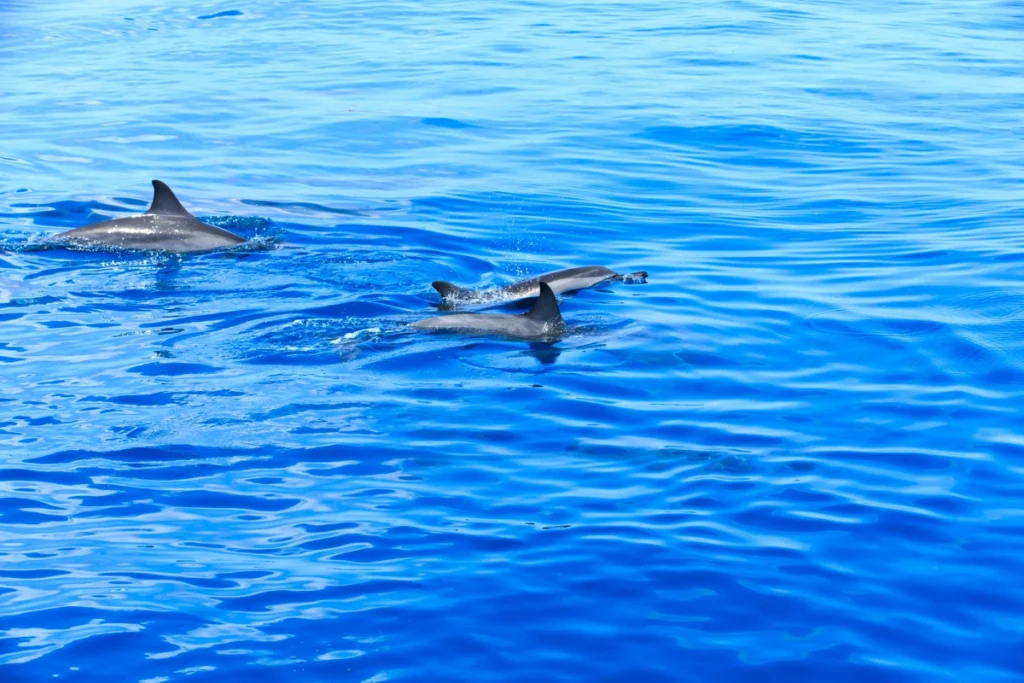
Not only dolphins: here are 15 incredible species you can meet. When you book a dolphin sighting Golfo Aranci with Nautical Service, you actually enter a natural theatre populated by minke whales, turtles, tuna, groupers and more. This article is a visual and practical guide at Golfo Aranci marine species. Read it in five minutes and you will know exactly what to look for, when and where.
1. Cetaceans (5 species)
In addition to the protagonists of the’dolphin sighting Golfo Aranci, here are five other cetaceans you may encounter.
| Species | Dimensions | Where to see it | Period | Probability |
|---|---|---|---|---|
| Common fin whale | Up to 24 m / 80 t | Deep waters between Tavolara and Corsica | April-June | Media (dedicated releases) |
| Striped dolphin | 2.2 m / 90 kg | Cape Figari, open waters | June-September | High |
| Grampo | 3.5 m / 500 kg | North of Golfo Aranci | September-October | Low-medium |
| Sperm whale | 18 m / 45 t | Beyond 5 miles from the coast | October-December | Very low |
| Bottlenose dolphin | 3.5 m / 300 kg | The whole gulf | May-September | Altissima (95%) |
Common fin whale - quick factsheet
Second largest animal on the planet
6-metre-high vertical blow
Feeds on krill (filters 2,000 litres of water per mouthful)
Council: exit at 7:00 a.m. with Nautical Service
Striped dolphin - quick factsheet
The most acrobatic: jumps in series of 5-6 somersaults
Recognisable by the black stripe from eye to tail
It lives in herds of 20-50 individuals
Curiosity: often swims under the bow of the bank (“surfing”)
Grampo - quick factsheet
Body full of white scars (fighting and squid)
Bulbous head (looks like a miniature sperm whale)
Preys on squid at a depth of 500-1,000 metres
Rare: Report to the skipper if you see him
Sperm whale - quick factsheet
World's largest tooth predator
Diving up to 2,000 metres for 90 minutes
Low, wide, direct blow to the left
Outstanding: 5-6 sightings per year
Bottlenose dolphin - the common dolphin
What everyone knows and loves
Intelligent, curious, approaches boats
It lives in family herds of 5-15 individuals
Guaranteed: in the 95% of Nautical Service outputs
2. Sea turtles
| Feature | Detail |
|---|---|
| Species | Caretta caretta (loggerhead turtle) |
| Dimensions | 1.2 m / 150 kg |
| Where | Capo Figari, Tavolara Reserve |
| Period | May-September (peak August) |
| What he eats | Jellyfish, algae, crustaceans, dead fish |
| Acknowledgement | Heart-shaped, reddish-brown carapace, large head |
What to do if you see one:
✅ Keep a distance of 10 metres
✅ Observe in silence (do not shout)
✅ If it is on the surface, it may be sleeping - don't wake it up
✅ If entangled in plastic or fishing line, immediately alert the skipper
❌ Never touch it (stress, it can bite)
❌ Don't feed it
❌ Do not attempt to mount it or take selfies
Important fact: The Caretta caretta is critically endangered species (IUCN Red List). Every sighting is valuable for biologists.
3. Iconic fishes (4 species)
Here are 4 “legendary” fish you may encounter during the snorkelling with Nautical Service.
Bluefin tuna (Thunnus thynnus)
| Feature | Detail |
|---|---|
| Dimensions | Up to 3 m / 500 kg |
| Speed | 70 km/h in sprint |
| Where | Passages between Cape Figari and Tavolara |
| When | May-June (ascent), September-October (descent) |
| What it does | Hunting in packs (“tuna”), jumping out of the water |
Signs of sighting:
Sudden water splashes on the surface
Diving birds (following schools of fish)
“Kettles” - water that seems to boil
Mediterranean barracuda (Sphyraena sphyraena)
| Feature | Detail |
|---|---|
| Dimensions | 1.5 m / 8 kg |
| Dangerousness | Low (no documented attacks in Sardinia) |
| Where | Rocky seabed of Tavolara and Capo Figari |
| Depth | 10-30 m |
| Acknowledgement | Silvery body, mouth with sharp teeth, large eyes |
Correct behaviour:
✅ Observe, do not fret
✅ Keep your eyes on him (predators attack if you show your back)
✅ Back away slowly
❌ Do not touch it (sharp teeth)
Brown grouper (Epinephelus marginatus)
| Feature | Detail |
|---|---|
| Dimensions | Up to 1.5 m / 60 kg |
| Maximum age | Over 50 years |
| Where | Tavolara Reserve (protected, no fishing) |
| Behaviour | Very confident, approaching divers |
| Acknowledgement | Massive spotted body, yellowish eyes, spiny fins |
Curiosity: Groupers are proterogynous hermaphroditesThey are born as females and become males after the age of 10-12 years. Those from Tavolara have names given by biologists (“Gigia”, “Brutus”).
Sunfish (Grinding wheel)
| Feature | Detail |
|---|---|
| Dimensions | 3 m diameter / 2 tonnes |
| Birth weight | 2 mm / fraction of a gram (250 million eggs) |
| Where | Surface, let yourself be carried along by the current |
| When | July-August (warm water) |
| Behaviour | Emerges to be cleaned by the fish and get warm |
Immediate recognition:
Flat, almost round body
High dorsal and anal fins
Swim on your side, eye upwards
It looks like a giant head with fins
Why it is called “sunfish”: When he emerges and turns on his side, his silvery body reflects the light like a full moon.
4. Invertebrates
During stops snorkelling of Nautical Service, don't just look for fish. The small inhabitants are just as spectacular.
| Species | Where to find it | Depth | Visibility | Permission to touch? |
|---|---|---|---|---|
| Red starfish | Posidonia meadows | 3-15 m | High | ❌ No (stresses) |
| Spiny starfish | Rocky bottoms | 10-25 m | Media | ❌ No (stinging tips) |
| Common sea urchin | Everywhere | 1-20 m | High | ❌ NO (very painful!) |
| Rock Urchin | Cracks and crevices | 5-30 m | Low | ❌ No |
| Red gorgonian | Walls of Cape Figari | 15-50 m | Media (sub) | ❌ No (grows 1 cm/year) |
| Red coral | Caves of Capo Figari and Tavolara | 20-80 m | Low (sub-experts) | ❌ No (protected species) |
| Date of the sea | Limestone rocks | 5-20 m | High | ❌ NO (illegal to fish) |
| Common octopus | Ravines and grottoes | 3-30 m | Low (blends in) | ❌ No (bites) |
| Manto (breed) | Sandy bottoms | 5-40 m | Low (stands on the bottom) | ❌ No (sting) |
Warning - real dangers:
Sea urchin: the thorns break through the skin. If you step on them, get out of the water and ask for help. Do not remove the thorns with your hands.
Luminous jellyfish (Pelagia noctiluca): pungent, causes burning. Recognisable by the pink/purple body. Warn the skipper.
Trachina (spider fish): slips into the sand, has poisonous spines on its dorsal fin. It wears snorkelling shoes.
5. Seabirds
Even above water, the show is guaranteed.
| Species | Where to observe it | Period | Behaviour |
|---|---|---|---|
| Cormorant | Rocks of Capo Figari, stacks of Tavolara | All year round | He stands motionless with open wings to dry |
| Major Bertha | Open waters between Golfo Aranci and Tavolara | April-October | Flying low over the water, he dives to fish |
| Peregrine Falcon | Vertical walls of Cape Figari | All year round | Hunting birds in the air - spectacular! |
| Herring Gull | Everywhere | All year round | Warning: stealing food if you eat outdoors |
| Grey heron | Golfo Aranci wetlands (pond) | Autumn-winter | Standing still in shallow water |
Tip for photographers: The Major Bertha is difficult to photograph because it flies fast and erratically. Use shutter speeds above 1/2000s.
6. Summary table: where and when to sight
| Species | Best zone | Depth | Best period | Better time |
|---|---|---|---|---|
| Whale | Between Tavolara and Corsica | >200 m | April-June | Morning (7:00-9:00) |
| Stenella | Cape Figari | 50-200 m | June-September | All day |
| Tursiope | The whole gulf | 10-100 m | May-September | Morning and late afternoon |
| Turtle | Tavolara Reserve | 5-30 m | August | Noon (snorkelling stop) |
| Tuna | Cape Figari-Tavolara Passage | 20-50 m | May-June | Morning |
| Grouper | Tavolara (protected area) | 10-40 m | June-September | Afternoon (water + hot) |
| Sunfish | Surface, wide | 0-5 m (surfacing) | July-August | Noon |
| Red coral | Caves of Cape Figari | 25-60 m | All year round | Only for certified divers |